Shake in a jar
Start here- Time
- 30 seconds
- Kit
- Any jar with a lid
- Texture
- Smooth, with a light foam
The default. Nothing else is this fast, and the result is close enough to whisked that the difference only shows on good ceremonial grade.

Almost every guide tells you to whisk matcha with hot water and pour it over ice. That works, but it is the long way round and it extracts more bitterness than you need. Cold water and a jar do the job in thirty seconds and taste sweeter for it.
The short answer
Sift 2 g of matcha into a jar, add 60 ml of cold water, seal it and shake hard for 20 seconds. Fill a tall glass with ice, pour the matcha over, and top with 180 ml of cold water or milk. Cold water extracts far less of matcha's bitter catechins than hot water, so iced matcha tastes sweeter without any sweetener added.
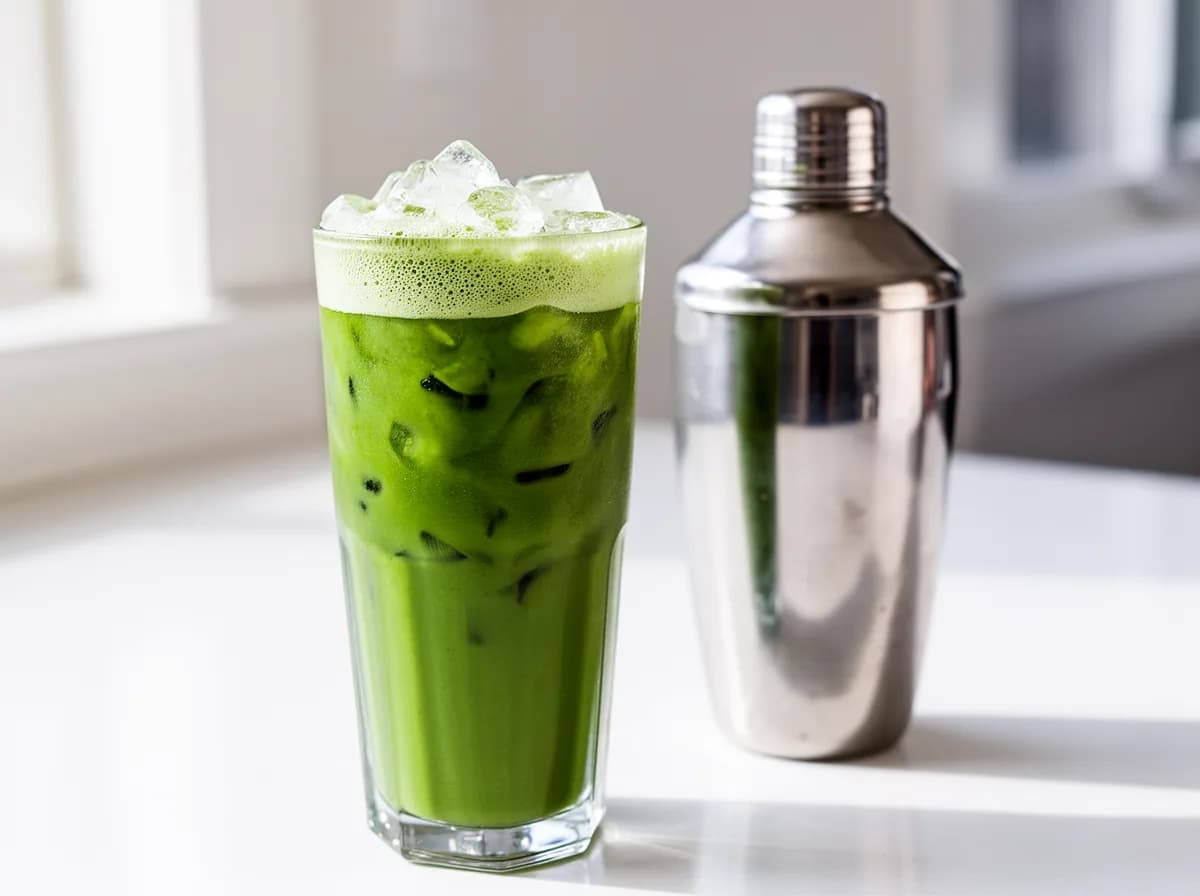
All three produce good iced matcha. They differ in how long they take, what equipment they need, and how much bitterness ends up in the glass.
The default. Nothing else is this fast, and the result is close enough to whisked that the difference only shows on good ceremonial grade.
Whisk with 60 ml of water at 70–80 °C, then pour over ice. Best flavour and texture, and the only method worth using on expensive matcha — but the hot water extracts more bitterness before the ice ever cools it.
Shake matcha into cold water and leave it in the fridge overnight. The least bitter result of the three by a clear margin, and the easiest way to make several servings at once. Shake again before pouring.
Sift the matcha into a jar or shaker bottle. Cold water wets matcha far more slowly than hot, so an unsifted powder will clump and stay clumped — this step matters more for iced than it does for hot.
Add 60 ml of cold water, seal the jar, and shake hard for 20 seconds. Leave the jar no more than half full so the powder has room to move; a full jar cannot generate the turbulence that breaks the particles apart.
Fill a tall glass to the top with ice. A full glass melts more slowly than a half-full one, so more ice means a less watery drink, not a more watery one.
Pour the shaken matcha over the ice, then top with the remaining 180 ml of cold water for plain iced matcha, or cold milk for an iced matcha latte.
Stir once and drink. Matcha is a suspension rather than a solution, so it will start to settle within a few minutes — that is normal, and a quick stir brings it back.
The commonest mistake with iced matcha is using a hot-bowl amount of powder in a glass that holds three times as much liquid. Scale the matcha with the glass, not the habit.
| Glass | Matcha | Water to shake | Top up with | Ice |
|---|---|---|---|---|
| 8 oz / 240 ml | 1.5 g | 45 ml | 120 ml | ≈5 cubes |
| 12 oz / 350 ml | 2 g | 60 ml | 180 ml | ≈7 cubes |
| 16 oz / 475 ml | 3 g | 60 ml | 250 ml | ≈10 cubes |
| 24 oz / 700 ml | 4 g | 90 ml | 380 ml | ≈14 cubes |
Top-up figures assume the glass is filled with ice first. Ice displaces roughly a third of the volume, and then adds it back as it melts.
Temperature decides what comes out of the leaf. Matcha's bitterness and astringency come from catechins, which need heat to release readily; its sweetness and savoury depth come from amino acids, which come through at any temperature. Make matcha with cold water and you shift the balance towards the sweet side without adding anything. This is why people who dislike hot matcha often like iced, and why iced matcha is far more forgiving of a cheap tin.
The trade-off is texture. Cold water wets the powder more slowly, so it clumps more readily and foams less than a properly whisked hot bowl. Sifting fixes the clumping; the foam you simply get less of, which is a fair price for a drink that needs no sweetener.
Unsifted powder, made worse by cold water
Sift before shaking. If you have no sifter, hydrate with 15 ml of warm water and shake that into a paste first, then add the cold water.
Too much matcha for the volume, or a late-harvest powder
Drop to 2 g per 350 ml. If it is still harsh, the grade is the problem rather than the ratio — cold water hides a lot, and anything that survives it is genuinely bitter tea.
Ice melting into an under-strength base
Fill the glass with ice rather than part-filling it, and use larger cubes. A full glass of ice melts more slowly than a few cubes in a lot of liquid.
Nothing — this is what a suspension does
Stir it. Matcha is ground leaf held in water, not dissolved in it, so settling is expected behaviour rather than a fault in your technique.
Stale matcha, or a low grade to begin with
Check the powder dry in the tin. Fresh matcha is vivid jade; olive or brown means oxidised, and no method recovers it.
Too little headroom in the jar, or a gentle shake
Half-fill the jar at most and shake hard for a full 20 seconds. Foam on iced matcha comes from aeration, and aeration needs empty space.
Every drink below starts with the same shaken base. Only what you pour over it changes.
Iced matcha latte →
The same base topped with cold milk instead of water.
Iced shaken matcha →
Shaken with ice in the jar for more foam and a colder start.
Strawberry matcha →
Strawberry purée at the bottom, milk, then matcha on top.
Matcha lemonade →
Lemon and matcha — sharper, and no milk to mute the tea.
Which milk to use →
Oat wins on froth. Almond is the one to avoid.
Matcha ratio calculator →
Work out the powder for any glass size you actually own.
Yes, and it is arguably the better way to drink it. Sift 2 g of matcha into a jar, add 60 ml of cold water, seal it and shake for 20 seconds. Cold water extracts far less of matcha's bitter catechins than hot water does, so the result reads sweeter and is more forgiving of a mediocre powder.
2 g — about one rounded teaspoon — for a 12 oz / 350 ml glass. Scale to roughly 1.5 g for a small 8 oz glass and 3 g for a 16 oz one. Iced drinks carry more liquid than hot ones, so using the same amount as a hot bowl will taste thin.
Temperature decides what comes out of the leaf. Catechins — the compounds responsible for matcha's bitterness and astringency — extract much more readily in hot water, while the amino acids behind its sweetness and umami come through at any temperature. Cold water therefore shifts the balance towards the sweet side without you adding anything.
Make the base exactly as above, then top with cold milk instead of water. For the layered café look, pour the milk into the glass first, add ice, and float the shaken matcha on top. Our full iced matcha latte recipe covers the milk choices and ratios in detail.
Yes — and it will taste better for it. Shake matcha into cold water, seal it and leave it in the fridge for six to eight hours. This cold-steep method produces the least bitter result of any method. Keep it under 24 hours and shake again before pouring, because the powder settles.
No. Ice, dilution and any sweetener flatten exactly the delicate qualities you pay for in ceremonial grade. A good culinary or latte-grade powder has more body and holds up better in a cold drink, at a fraction of the price. Save ceremonial grade for a hot bowl.
Because matcha never actually dissolves — it is ground leaf suspended in water, and cold water wets those particles much more slowly than hot water does. Sifting solves it. Failing that, mix the powder into 15 ml of warm water to a smooth paste first, then add the cold water.
Plain iced matcha made with water has essentially no calories and no sugar, so on those two measures it is the lighter drink. The latte adds whatever the milk brings, plus any sweetener. Neither is unhealthy; the difference is entirely in what you add to the tea.
Roughly 60 to 70 mg for a 2 g serving, which is what a standard 12 oz glass uses. Ice and dilution change the volume, not the caffeine — the number follows the powder, not the water. Our caffeine calculator works it out for whatever serving you actually use.
The Ultimate Matcha Guide
$4.99$10launch
