
Strawberry Matcha
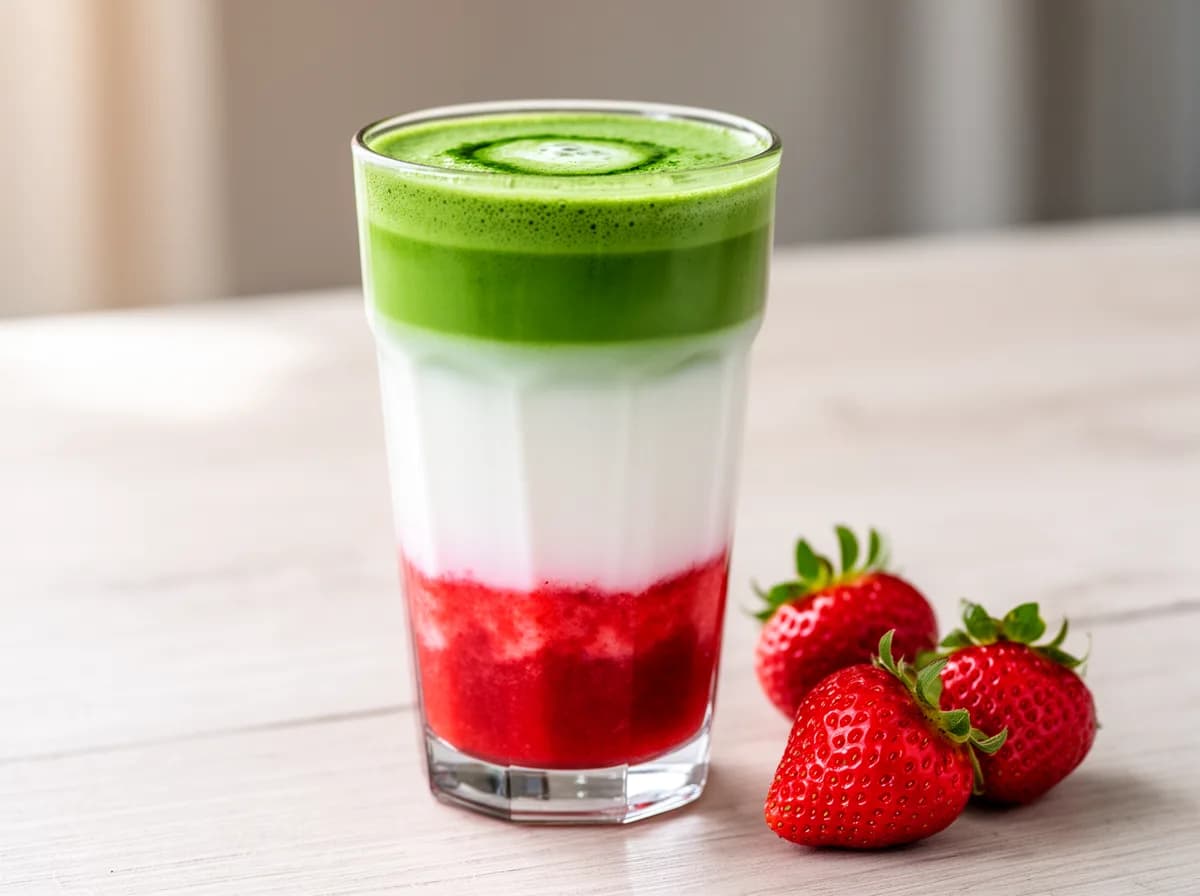
Strawberry matcha looks fancy but it's just three things stacked: strawberry purée at the bottom, milk in the middle, matcha on top. The trick is keeping the layers separate — pour slowly over the back of a spoon and they hold beautifully until you stir them together at the first sip.
- Prep time
- 7 minutes
- Servings
- 1 glass (400 ml)
- Difficulty
- Easy
Which strawberry preparation to use
| Preparation | Layers cleanly? | Tastes like | Prep | Keeps |
|---|---|---|---|---|
| Fresh mashed purée | Yes — sugar makes it the densest thing in the glass | Bright, properly fruity, pleasantly chunky | 5 min | 5 days, fridge |
| Frozen mashed purée | Yes — the best layer of the lot | Often better than fresh out of season; freezing ruptures the cells so it releases more juice | 5 min | 5 days once thawed |
| Bought strawberry syrup | Yes, and the cleanest line of all | Candy-like and one-note — this is the café shortcut, and it tastes like one | None | Months |
| Jam, thinned with hot water | Poorly — it clumps against cold milk | Cooked and dull; the pectin gives it a set, slightly gluey body | 2 min | Months |
| Freeze-dried strawberry powder | No — it disperses instead of sitting at the bottom | Intense concentrated berry, but no bulk and no texture | 1 min | Months |
| Strawberry cold foam | It goes on top, not the bottom — a different drink | Creamy and mild, with the fruit reading as aroma more than flavour | 3 min | Make it fresh |
Density is what decides the layers. Anything you want at the bottom has to be heavier than milk, which in practice means it needs sugar in it — this is why a lightly sweetened purée layers worse than a heavily sweetened one, and why powder does not layer at all.
Nutrition, per serving
- Calories
- 215 kcal
- Carbs
- 38 g
- Sugars
- 32 g
- Fat
- 3.5 g
- Protein
- 3 g
- Fibre
- 3 g
An estimate for the recipe exactly as written, per 1 glass (400 ml). Swapping the milk or the sweetener changes it — the milk is usually the largest single line.
What is a strawberry matcha?
A strawberry matcha is the layered café drink: strawberry purée at the bottom, cold milk and ice in the middle, whisked matcha floated on top. It grew out of Asian and Australian café culture in the late 2010s, went global on the strength of being extremely photogenic, and stuck around because the combination genuinely works — the drink converts more matcha skeptics than any other recipe on this site.
The reason it converts them: the strawberry and milk carry the first sip, so matcha arrives as a finishing note instead of a frontal vegetal hit. By the time you've stirred the layers together, you're drinking a fruit-milk-tea blend where the matcha reads as depth rather than as grass.
What does strawberry matcha taste like?
Tart-sweet fruit up front, creamy milk through the middle, and matcha's vegetal-sweet finish at the back — in that order, because that's the order the layers hit as you sip and stir. The strawberry's acidity does the same job lemon does in matcha lemonade: it mutes bitterness and makes matcha's natural amino-acid sweetness pop.
Well made, nothing dominates. If the drink tastes only of strawberry milk, the matcha dose was too small or the grade too mild; if it tastes sharp, the matcha was overdosed or the water too hot. The 150 g fruit to 1 tsp matcha ratio in this recipe is the tested middle.
The layering, explained
The layers are density physics, nothing more. The sugar-macerated purée is the densest thing in the glass, so it stays at the bottom. Milk is denser than whisked matcha (which is mostly water plus suspended powder and foam), so the matcha floats. Every layered café drink — including the espresso version of this trick — works on the same principle: pour in order of density, heaviest first.
Pouring order and speed are where it goes wrong. The ice isn't decoration — it breaks the milk's fall so it doesn't punch into the purée, and the back-of-a-spoon trick does the same for the matcha landing on milk. Pour each layer slowly against the ice or the spoon and the drink holds its stripes until the first stir.
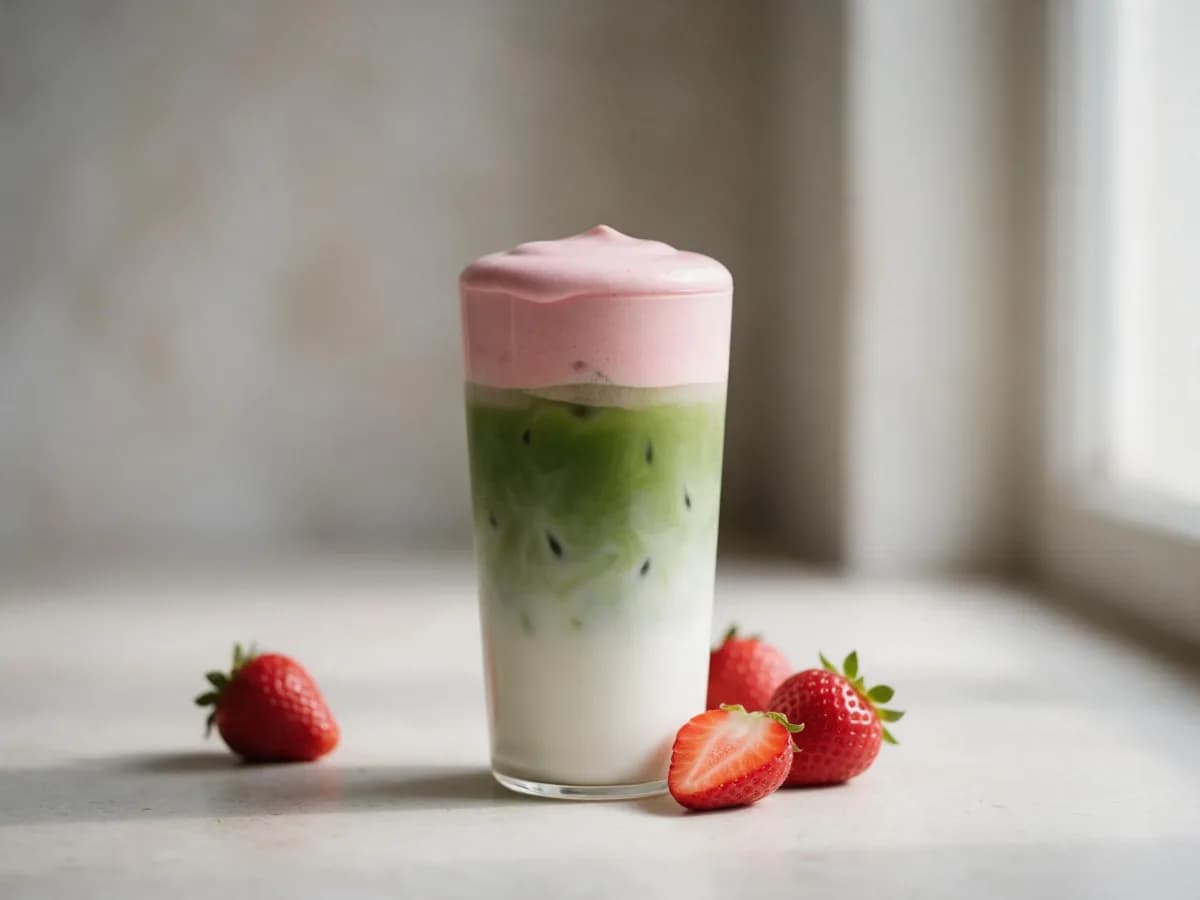
Strawberry cold foam, if you want the other version
The layered drink puts strawberry at the bottom. The cold-foam version puts it on top, and it is a genuinely different drink rather than a garnish: you drink through a cold, lightly whipped strawberry cream into plain matcha underneath, so the fruit arrives as aroma on every sip instead of as a sweet base you stir in.
To make it, whisk 50 ml of cold double cream or cold oat barista milk with a tablespoon of the strawberry purée and a teaspoon of sugar until it just thickens — about 30 seconds with a hand frother. Stop while it still pours; a stiff foam sits on the surface like a lid instead of blending as you drink. Build the glass as iced matcha with milk, then spoon the foam over the top.
Use this version when the matcha is good enough to taste on its own. The layered purée version buries the tea under fruit by design, which is exactly why it converts sceptics — but it also means a nice tin is wasted on it.
Café-style upgrades
Milk: oat and whole milk are the café standards for a reason — both have enough body to hold a layer and enough sweetness to bridge fruit and tea. Skim and most almond milks are too thin; the layers blur and the drink tastes hollow.
The purée: a quarter teaspoon of vanilla extract in the strawberry purée is the single cheapest upgrade — it rounds out sour berries and reads unmistakably café. Making a bigger batch of purée is the second one; it keeps five days and turns this into a 3-minute drink.
The matcha: culinary grade is genuinely fine here — the fruit and milk would bury a ceremonial grade's nuance, so save the good tin for plain bowls. And if you want the full flourish, whip 50 ml of cream with a spoonful of the purée into a loose strawberry foam and float it as a fourth layer.
Ingredients
- 150 g fresh or frozen strawberries
- 1–2 tbsp sugar (or honey)
- 1 tsp lemon juice — optional, brightens the strawberry
- 1 tsp matcha powder
- 60 ml warm water (~75 °C)
- 200 ml cold milk (oat or whole)
- Ice — fill the glass
Instructions
- 1Mash the strawberries with sugar and lemon juice in a bowl. Don't blend smooth — chunky purée looks better and tastes brighter.
- 2Spoon the strawberry purée into the bottom of a tall glass. Add ice on top until three-quarters full.
- 3Pour the cold milk slowly over the ice. The ice slows it down and keeps the strawberry layer underneath.
- 4Sift matcha, whisk with the warm water until smooth. Pour the matcha gently over the back of a spoon onto the milk for a clean third layer.
- 5Serve with a long spoon. Stir at the table.
Tips
- Frozen strawberries actually work better — they release more juice when mashed.
- If your strawberries are sour, add a splash of vanilla extract along with the sugar.
- Use a wide glass — the layered look needs surface area.
FAQ
Can I make strawberry matcha without sugar?
Yes — use ripe strawberries and substitute mashed banana or a date for sweetness. The drink will be less bright but still good.
What's the strawberry-to-matcha ratio?
Roughly 150 g strawberries to 1 tsp matcha. Strawberry should lead; matcha is the finishing accent.
Why use lemon juice?
It lifts the strawberry flavor and prevents the purée from going dull-pink in the glass.
How much caffeine is in a strawberry matcha?
About 33 mg with the standard 1 tsp of matcha — a third of a cup of coffee. Café versions made with 2 tsp run closer to 66 mg. The strawberry and milk add zero caffeine, so the powder dose is the whole answer.
Can I use strawberry syrup or jam instead of purée?
Syrup works and layers even more cleanly (it's denser), but tastes candy-like rather than fresh. Jam is the weakest option — it's cooked, overly set, and clumps in cold milk. Thin 2 tbsp of jam with a teaspoon of hot water if it's what you have.
Why did my layers mix?
Pouring too fast, or a purée that's too thin. The layers hold because the sugar-heavy purée is denser than milk and the whisked matcha is lighter — pour the milk slowly over ice and float the matcha over the back of a spoon, and don't skimp the sugar in the purée.
How do I make strawberry matcha with syrup instead of fresh fruit?
Use 2 tablespoons of strawberry syrup in place of the purée and build the glass the same way. Syrup is denser than purée, so the layers hold even more cleanly — the trade-off is entirely flavour, since syrup tastes candied rather than fruity. It is the right choice when strawberries are out of season and the supermarket ones are pale and sour.
What is matcha with strawberry cold foam?
The inverted version of this drink: plain iced matcha latte underneath, with a lightly whipped strawberry cream floated on top instead of purée at the bottom. You taste the fruit as aroma on every sip rather than stirring it through, and the matcha stays legible — worth making if your matcha is good enough to taste.
Is strawberry matcha healthy?
It's a reasonable treat: roughly 150–220 calories with oat or whole milk, most of it from the milk and the 1–2 tbsp of sugar in the purée. Real fruit, real tea, and about half the sugar of a café version — see our matcha calories guide for the full breakdown.
