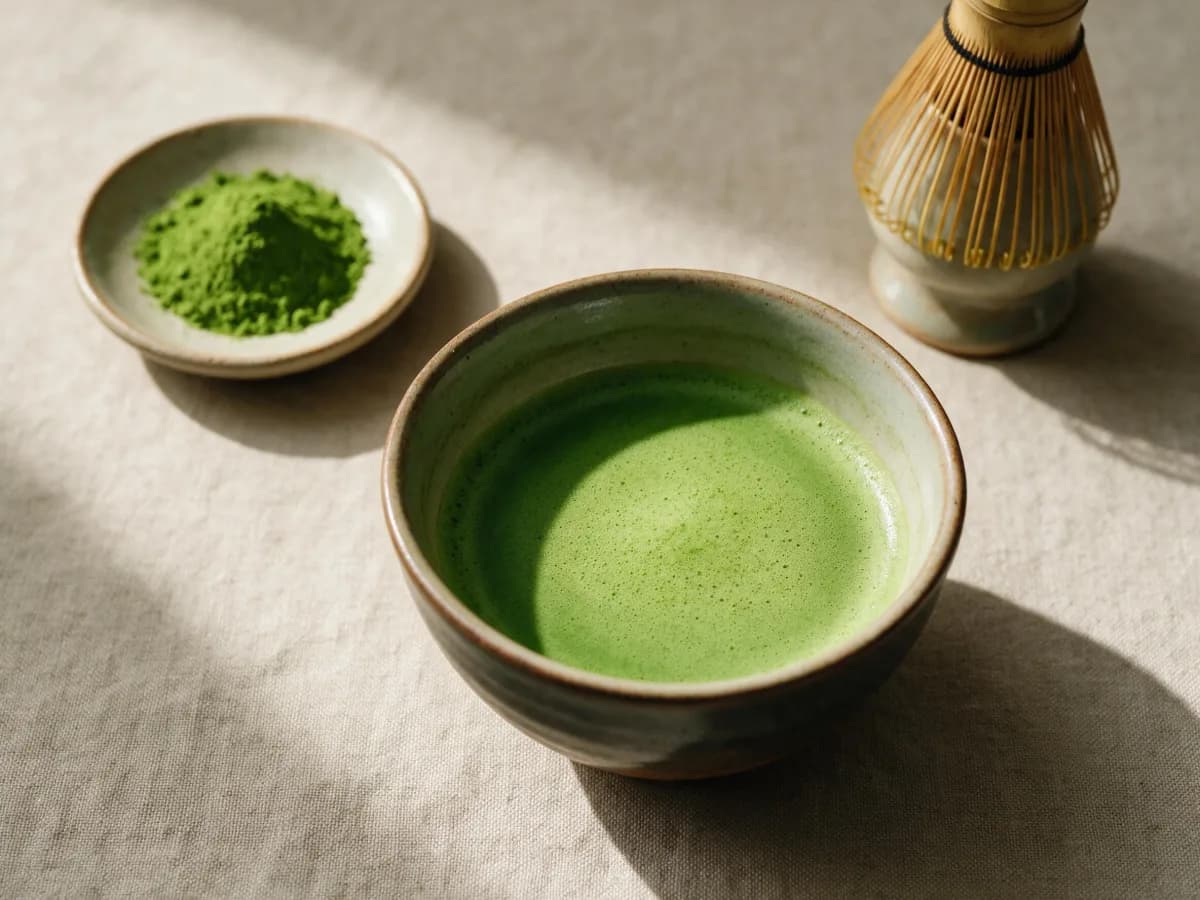
Matcha tastes umami, vegetal, and lightly sweet, with a clean bitter finish.Good ceremonial matcha is closer to a savory broth than to other teas: smooth, slightly buttery, with a sweet aftertaste. Cheaper grades and matcha brewed with boiling water taste sharper and more like grass. It's a flavor that doesn't map onto anything most new drinkers already know, which is part of the reason people describe it so differently.
The colour difference between the dry powder and the whisked bowl is the first thing that tells you what a matcha will taste like. Illustration generated with AI.
Last updated September 2026 · 9-minute read
Matcha flavor profile at a glance
Typical intensity of each note on a 0–5 scale, for a bowl made correctly at 70–80 °C. Grade shifts the balance rather than the notes themselves — culinary matcha is not a weaker ceremonial, it is a different distribution.
Matcha flavour notes with typical intensity by grade, and what each note tastes like
Note
Ceremonial
Culinary
Reads like
Umami
5 / 5
2 / 5
Light dashi broth, nori
Vegetal
3.5 / 5
4.5 / 5
Steamed spinach, asparagus
Sweetness
4 / 5
1.5 / 5
Sweet peas, white chocolate
Bitterness
1.5 / 5
3.5 / 5
Dark chocolate's clean snap
Astringency
1 / 5
3.5 / 5
The dryness of strong black tea
The full tasting notes in one table — how strong each note is in a well-made bowl of quality matcha, and what it reads like to a palate that's never tried it. Grade and preparation shift the proportions (details further down), but the profile itself is always these six.
Note
Intensity
Reads like
Umami (savory)
Strong — the lead note
Light dashi broth, nori, parmesan's savory depth
Sweetness (natural)
Moderate, rises with grade
Sweet peas, fresh corn, edamame; white chocolate in milk
Vegetal (green)
Moderate to strong
Steamed spinach, asparagus; grass in lower grades
Bitterness
Light and brief when well made
Dark chocolate's clean snap, not coffee's roast
Astringency
Faint
The gentle dryness of strong black tea or red wine
Texture
Defining, often overlooked
Creamy and full-bodied — closer to a thin broth or silky cocoa than to watery tea, with a fine micro-foam when whisked well
If you had to describe matcha in one sentence: savory-sweet like a light broth, green like steamed spinach, creamy in texture, with a brief clean bitter finish.
What people compare matcha to
No single comparison nails it. Matcha sits between a handful of flavors most people already have words for, depending on the grade and how you serve it. The ones that come up most often:
Broth or dashi
The umami in matcha — driven by L-theanine and glutamic acid — is the same family of savory compounds you taste in Japanese soup stock. This is the comparison most ceremonial-grade drinkers reach for first.
Fresh spinach or edamame
Steamed-leaf vegetables share matcha's chlorophyll-rich, slightly sweet vegetal note. If you like raw spinach in a smoothie, matcha will land easier than you expect.
Sushi rice with a little nori
Sweet-savory umami with a faint marine edge. The marine note comes from amino acids built up during shading — the same process used for nori-style aquatic plants.
Strong steeped green tea
Matcha is recognizably in the green-tea family — vegetal and slightly grassy — but two to three times more concentrated, and creamier in mouthfeel because you drink the leaf.
Wheatgrass or fresh-cut grass
Lower-grade or freshly-opened culinary matcha leans here. Not unpleasant if balanced; sharp and one-note when overheated or used in too high a dose.
White chocolate (in a latte)
When matcha hits warm milk, the L-theanine sweetness reads almost dessert-like. Cafés lean on this — a quality matcha latte often needs no sugar at all.
The five flavor notes
Matcha is a balance of these five — proportions shift with grade, freshness, and preparation. A well-made bowl hits all five in sequence: umami first, vegetal middle, sweet finish, with a brief clean bitter edge and a faint dry astringency.
Umami (savory)
The defining note in good matcha — broth-like, deep, lingering. Comes from L-theanine and free amino acids that shading concentrates in the leaf. Strong umami is the single best predictor of quality matcha.
Vegetal (green)
Fresh, leafy, like spinach or asparagus. Brighter in young leaves used for ceremonial grade; sharper and more grass-like in older leaves used for culinary.
Sweet (natural)
Subtle, not sugary. Comes from amino acids and rises with shading time. Strongest in premium ceremonial matcha — sometimes described as buttery, milky, or like white chocolate.
Bitter (clean)
Catechins (the antioxidant compounds, especially EGCG) carry a light bitterness. In good matcha, bitterness is brief and balanced; in over-extracted or hot-water matcha, it dominates and lingers.
Astringent (drying)
A faint mouth-drying quality, like strong black tea or red wine. Pleasant in small amounts — adds structure and finish. Unpleasant when sharp, usually from low-grade powder or boiling water.
Is matcha sweet or bitter?
Both, in a specific proportion: naturally, mildly sweet with a light, clean bitterness — and when it's well made, the sweetness leads. Matcha's sweetness isn't sugar; it comes from amino acids, chiefly L-theanine, that shading concentrates in the leaf. It reads like the sweetness in fresh peas or corn, and in a milk drink it can tip almost dessert-like. The bitterness comes from catechins and should register as a brief, dark-chocolate snap at the finish, not a lingering harshness.
Two levers control the balance. Sweetness rises with grade — ceremonial matcha, made from the youngest shaded leaves, carries the most amino acids, while culinary grade leans bitter by design. Bitterness rises with water temperature: above roughly 85 °C the catechins extract aggressively and take over the cup. A high-grade matcha whisked at 75 °C tastes distinctly sweet with no sugar added; the same tin scalded with boiling water tastes like the bitter matcha everyone complains about.
How different forms of matcha taste
The same powder can taste startlingly different depending on how you serve it. Six forms most people encounter, and what each actually tastes like:
Full umami expression
Whisked usucha (plain matcha, hot)
The traditional 2 g whisked bowl is the truest taste of matcha — savory, vegetal, slightly sweet, frothy. Ceremonial-grade tastes balanced and creamy; culinary-grade tastes sharp and grassy at this strength. If you want to know what matcha actually tastes like, this is the form to try.
Concentrated, paint-like
Koicha (thick matcha)
Twice the powder, half the water — this is matcha taken to its extreme. Glossy, almost syrupy, with intense umami and a sweet finish. Only top ceremonial grades work here; lower grades become unpleasantly sharp at this concentration.
Smooth, dessert-adjacent
Hot matcha latte
Warm milk softens matcha's edges. The umami quiets, the natural sweetness amplifies, and the whole drink tastes creamy — sometimes described as white chocolate, vanilla, or sweetened oatmeal. Most beginners prefer this form to plain matcha for the first month.
Bright, vegetal, sweeter
Iced matcha latte
Cold mutes bitterness more than hot does, so iced matcha latte tastes the sweetest of any common matcha drink. Vegetal notes stay fresh; the L-theanine sweetness pops. The most beginner-friendly form.
Fruity-vegetal contrast
Strawberry matcha
Strawberry purée contributes tart-sweet fruit notes that complement rather than mask matcha. The drink reads layered — fruit on the front of the tongue, vegetal-sweet matcha on the back. The recipe most likely to convert a skeptic.
Toasted, almost cocoa-like
Matcha in baking
Heat transforms matcha. Vegetal notes deepen into toasted, almost cocoa or roasted-pistachio flavors; sweetness from sugar amplifies the L-theanine character. Matcha cookies and cakes read closer to chestnut or genmaicha than to whisked matcha.
Common first reactions — and what they usually mean
How someone describes matcha on a first taste is a useful diagnostic for what went right or wrong in the bowl. Six reactions that come up over and over in tasting notes and tea forums:
"It tastes like grass"
Almost always culinary-grade matcha brewed with too-hot water. Cool the water (75 °C, not boiling), use ceremonial or premium grade, and the grassy edge becomes a balanced vegetal note.
"It's really bitter"
Three usual causes: water above 85 °C, too much matcha for the volume of water, or stale powder. Boiling water especially is the #1 reason new drinkers think they don't like matcha.
"It's not sweet at all"
Cafés add sugar, syrup, or sweetened milk. Plain whisked matcha is naturally only mildly sweet — its sweetness reads more like savory-sweet than sugary. If you expected dessert, try a latte first.
"I taste something marine, almost like seaweed"
Real, and not a flaw. Shading concentrates the same family of amino-acid compounds you find in nori. Some people love this; others dislike it. Drier-roasted matcha (rare) softens the marine edge.
"It tastes nothing like green tea"
Correct — matcha's flavor is much richer and creamier than steeped green tea because you drink the whole leaf. The shading process also pushes matcha toward umami in a way regular green tea never reaches.
"It's good but I can't put my finger on what it tastes like"
Most common honest answer. Matcha sits between vegetable, broth, and tea — outside the categories most palates have words for. A few weeks of regular drinking and your vocabulary catches up.
Six factors that change matcha's taste
Two bowls from the same tin can taste like different drinks if you change the variables. Ordered roughly by how much they affect the result:
Grade
The biggest single variable. Ceremonial leans sweet, smooth, deeply umami. Premium / daily-grade is balanced, slightly more vegetal. Culinary is sharp, grassy, sometimes bitter — designed to survive milk and heat, not to drink plain.
Water temperature
Above 85 °C / 185 °F, matcha extracts more catechins (the bitter compounds) than amino acids. Stick to 70–80 °C. Boil and wait 90 seconds before pouring — this single change fixes most bitter-matcha complaints.
Freshness
Once opened, matcha loses its bright sweet character within four to six weeks. Olive-tinted matcha (instead of bright neon green) is past its prime — bitter notes hold but the sweet ones vanish. Refrigerate after opening.
Whisking technique
M-shaped whisking aerates matcha and softens harsh edges. Stirred matcha tastes one-note and chalky. Foam isn't a luxury — it's a flavor mechanism.
Origin and brand
Uji (Kyoto) matcha is sweetest and most nuanced; Kagoshima is bolder and grassier; Nishio sits between. Brand-to-brand differences within a region are real and noticeable side by side.
Water hardness
Soft, low-mineral water lets matcha's flavor through cleanly. Hard tap water flattens umami and accents bitterness. If your tap water is hard, switch to filtered for matcha — the difference is immediate.
If your matcha tastes wrong, run through these in order. The first step alone fixes the bowl in most cases.
1
Cool the water
Boil, then count slowly to 90 before pouring. Or use a thermometer for 70–80 °C. This single change accounts for roughly half of all 'matcha tastes bitter' complaints.
2
Sift before whisking
A small fine-mesh sieve over your bowl turns clumps into silk. Skipping this leaves pockets of bitter, concentrated powder.
3
Use less powder than you think
Start with 1 g (1 tsp) per 60 ml of water. Strong is bitter; balanced is delicious. You can always make a second bowl.
4
Try a different grade
If you're using culinary-grade plain, you're fighting the powder. Switch to ceremonial or premium for whisked matcha. Save culinary for lattes and baking where milk and sugar mask the sharpness.
5
Refrigerate the tin
Matcha oxidizes fast. Keep it sealed in the fridge after opening, and use within four to six weeks for the brightest flavor.
6
Try iced
Cold mutes bitterness more than hot. Iced matcha — even with the same powder — tastes noticeably sweeter and cleaner. The most forgiving form for beginners.
For the full preparation walkthrough, see the how to make matcha guide. For why the bitter cup happens in the first place, the bitter-matcha fix article walks through every cause.
Frequently asked
What does matcha taste like?
Matcha tastes umami, vegetal, and lightly sweet, with a clean bitter finish. Quality ceremonial matcha is creamy and broth-like — savory, smooth, almost buttery. Lower grades and overheated matcha taste sharper and grassier.
Does matcha taste good?
Most people find well-made matcha pleasant once they get past the unfamiliarity — it reads as savory-sweet rather than dessert-sweet, with a creamy mouthfeel that surprises new drinkers. The most common complaint ("too bitter") is almost always preparation, not the matcha itself.
Is matcha bitter?
Properly made matcha has only a light, balanced bitterness that fades quickly. Strong, lingering bitterness usually means water that was too hot (over 85 °C), too much powder for the volume, or stale or low-grade matcha. Cool the water first.
Is matcha sweet?
Naturally, mildly sweet — but not sugary. The sweetness comes from amino acids (especially L-theanine) that shading concentrates in the leaves. It reads more like the sweetness in fresh corn or sweet peas than like sugar.
Does matcha taste like green tea?
Same family of flavors — both are vegetal — but matcha is much richer, creamier, and sweeter. Where steeped green tea is light and grassy, matcha is umami-forward and almost soup-like. Side by side, they're clearly cousins, not twins.
Does matcha taste like grass?
Lower-grade matcha can lean grassy, especially when brewed with too-hot water. Quality ceremonial matcha tastes vegetal but creamy, more like spinach or edamame than like cut grass. If yours tastes like a lawn, the matcha is probably culinary grade or the water is too hot.
What does matcha latte taste like?
Smoother and sweeter than plain matcha. Warm milk mutes matcha's sharper edges and amplifies its natural L-theanine sweetness. The drink reads creamy, slightly vegetal, almost like a sweetened oatmeal or white chocolate. Iced matcha lattes are even more beginner-friendly — cold mutes bitterness further.
What does ceremonial-grade matcha taste like?
Smooth, sweet, and deeply umami — the closest matcha gets to broth in flavor and to silk in texture. Bitterness is brief and clean; the lingering note is sweet and savory rather than astringent. This is the grade to try if you want to understand why matcha has fans.
What does culinary-grade matcha taste like?
Sharper, more vegetal, and more bitter than ceremonial — designed to stand up to milk, sugar, and baking heat. Drunk plain, it tastes like aggressive green tea with a grassy edge. In a sweetened latte or ice cream, those same qualities give matcha its presence rather than overwhelming the drink.
Why does my matcha taste so bitter?
The three usual culprits: water temperature too high (over 85 °C / 185 °F), too much matcha for the volume of water, or low-quality / stale powder. Cool the water first; if that fails, check the freshness and grade of your powder.
Does matcha taste better with milk or water?
Different drinks. Plain matcha (water only) lets you taste the umami, sweetness, and complexity directly — best with ceremonial grade. Matcha with milk is smoother and more accessible — better for beginners or for a calmer everyday drink. Most regular drinkers do both.
Why do some matcha lattes taste sweet without sugar?
L-theanine — the amino acid in matcha — has a naturally sweet character that warm milk amplifies. A good matcha latte made with whole or oat milk often needs no added sweetener.
How would you describe matcha's flavour?
In tasting-note terms: savoury and broth-like on the front, vegetal through the middle, with a clean sweet finish and a brief bitter edge. British and American spellings describe the same drink — matcha flavour is usually written up as umami, grassy-sweet, and creamy, the last of which is texture rather than taste but is what most people actually remember.
Does matcha taste like seaweed?
A faint marine note is real in some matcha — shading concentrates similar amino-acid compounds to those in nori. Most drinkers register this as a savory edge rather than ocean. Lower-shaded culinary grades have less of this character; deeply shaded ceremonial grades have more.
Will I get used to the taste of matcha?
Almost always, yes. Matcha sits outside the flavor categories most palates have words for, so the first few cups feel unfamiliar. Two to three weeks of regular drinking and most people start enjoying it on its own — your palate develops vocabulary for the flavors that confused it at first.
How would you describe the taste of matcha in one sentence?
Savory-sweet like a light broth, green like steamed spinach, creamy in texture, with a brief clean bitter finish. If the person you're describing it to knows Japanese food, 'drinkable umami' gets you most of the way there.
What is the texture of matcha like?
Creamy and full-bodied — noticeably thicker than steeped tea, because you're drinking suspended leaf particles rather than an infusion. Well-whisked matcha adds a fine micro-foam that reads almost like a cappuccino's texture without the milk. Gritty or chalky texture means the powder wasn't sifted or the grind is coarse.
What are matcha's main tasting notes?
Six, in rough order of prominence: umami (broth-like savoriness), natural sweetness (peas, fresh corn), vegetal green (spinach, asparagus), a light clean bitterness, faint astringency, and — in deeply shaded grades — a subtle marine nori note. Higher grades push umami and sweetness forward; lower grades push vegetal and bitter notes forward.
What does strawberry matcha taste like?
Tart-sweet strawberry up front, creamy milk in the middle, and matcha's vegetal sweetness on the finish — the fruit complements the tea rather than masking it. It's the drink most likely to convert a matcha skeptic; our strawberry matcha recipe builds it layer by layer.
What does matcha lemonade taste like?
Bright and tart first, with matcha's vegetal note arriving underneath rather than on top — lemon's acidity mutes matcha's bitterness and makes the natural sweetness pop. If plain matcha reads too savory for you, lemonade is the most approachable cold format.